Single-fraction SABR pooled analysis, 1687 pts
ForPrimary NSCLC or pulmonary oligomets selected for single-fraction SABR
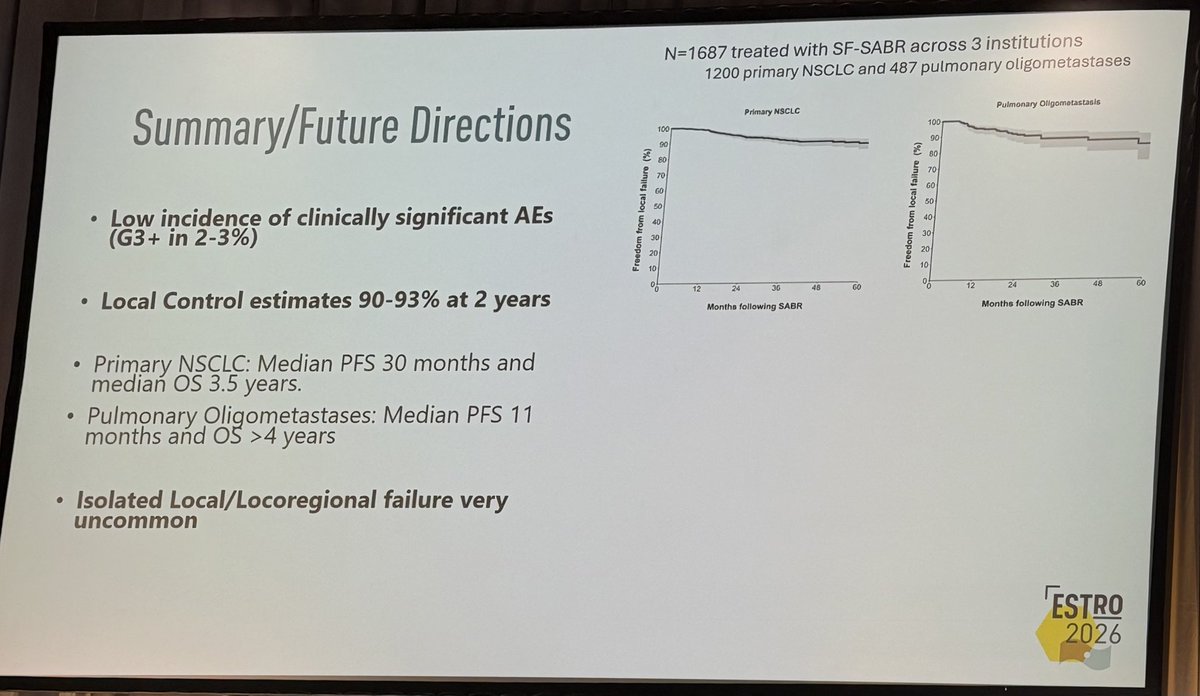
TL;DRLocal control 90-93% at 2yr and G3+ AEs 2.9% across 1687 single-fraction SABR pts at 3 centres.
The oligomet read is the gap between local control and PFS: 90-93% LC at 2yr against median PFS 11 mo, so distant failure, not the treated lesion, drives the course. For primary NSCLC the same LC sits with median PFS 30 mo, which is the split that should decide whether one-visit ablation is offered as definitive treatment or as a break from systemic therapy.
In early-stage primary NSCLC where visit burden drives the fractionation choice, this supports single fraction as a durable local option (LC 90-93% at 2yr, G3+ 2.9%); tumour location and operability are not reported, so who it represents stays open.
Local control holds at 90-93% at 2yr for a primary and for a metastasis alike, so the single fraction is not the variable separating outcomes; median PFS is (30 vs 11 mo). Tumour size and location go unreported, so the target selection behind that number is unmeasured.
For a pt with pulmonary oligometastases, one-visit ablation gave 90-93% local control at 2yr but median PFS of 11 mo, so it clears the treated lesion without changing the systemic course. That frames referral as a local step between systemic lines, not a substitute for one.
| Cohort | n | Median PFS | Median OS |
|---|---|---|---|
| Primary NSCLC | 1200 | 30 mo | 3.5 yrs |
| Pulmonary oligometastases | 487 | 11 mo | >4 yrs |
+2 more figures
| Endpoint | Primary NSCLC | Oligometastases |
|---|---|---|
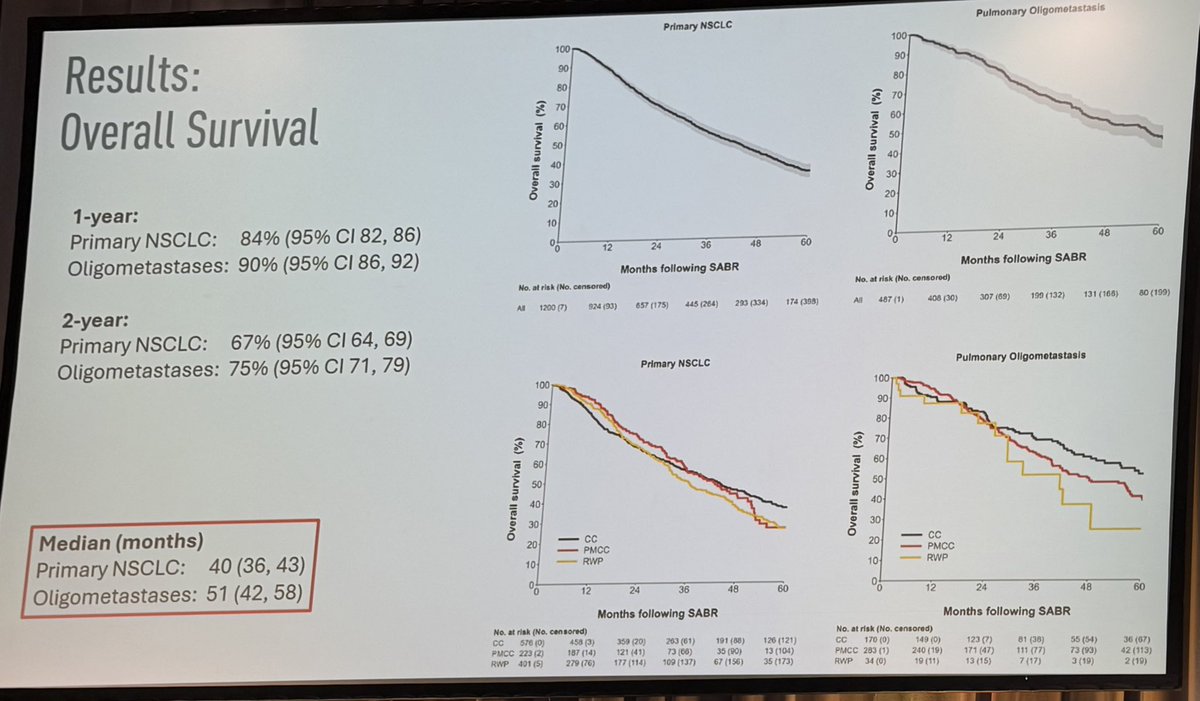
| 1yr OS | 84% (95% CI 82, 86) | 90% (95% CI 86, 92) |
| 2yr OS | 67% (95% CI 64, 69) | 75% (95% CI 71, 79) |
| Median OS | 40 mo (36, 43) | 51 mo (42, 58) |
| Adverse event (n=789) | n (%) |
|---|---|
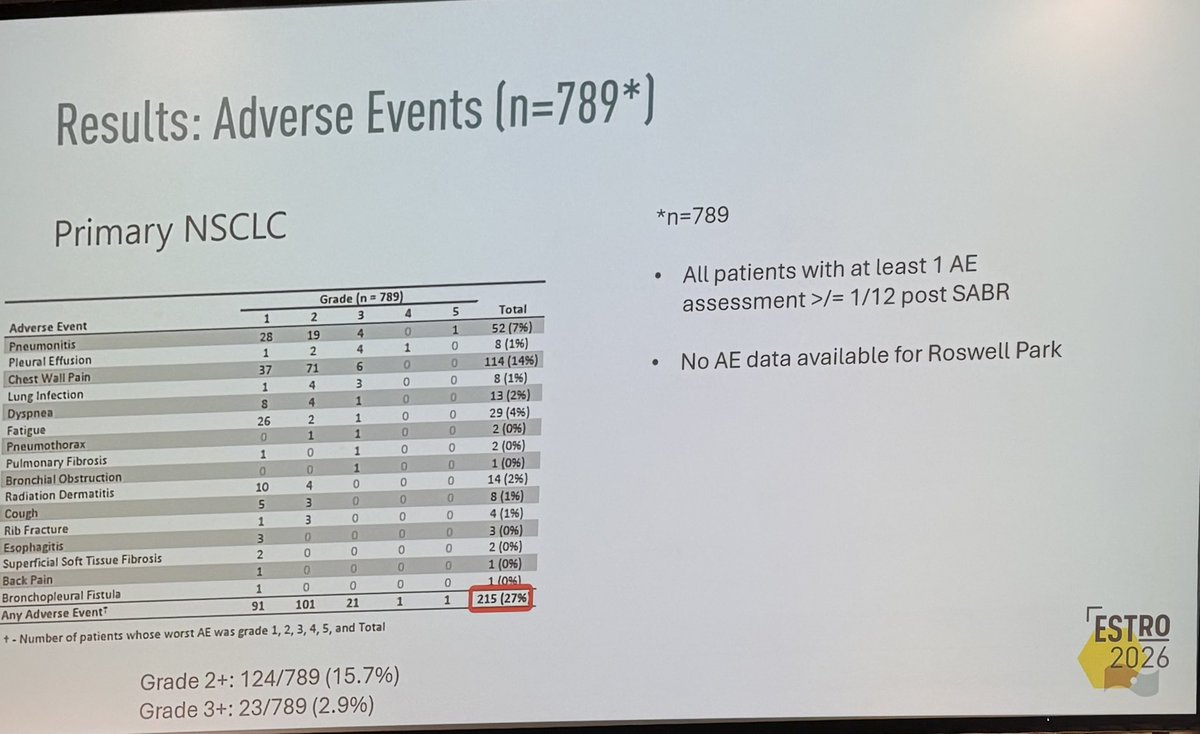
| Any AE | 215 (27%) |
| Grade 2+ | 124 (15.7%) |
| Grade 3+ | 23 (2.9%) |
| Chest wall pain | 114 (14%) |
| Pneumonitis | 52 (7%) |
| Fatigue | 29 (4%) |
| Dyspnea | 13 (2%) |
6 details
Pooled analysis of 1687 pts treated with single-fraction SABR at three centres (Peter MacCallum, Cleveland Clinic, Roswell Park): 1200 primary NSCLC and 487 pulmonary oligometastases. Whether the contributing cohorts were prospective or retrospective is not stated in source.
Eligibility, operability, tumour size and central vs peripheral location are not reported in source. Cohort mix differs sharply by centre: Roswell Park supplied 401 of the NSCLC pts but only 34 oligomet pts, while Peter Mac supplied 283 of 487 oligomet pts.
Single fraction throughout, but the prescribed dose is not reported in source. Without it the outcome cannot be mapped onto a schedule a reader could write, which is the one parameter that would carry this into planning.
No primary endpoint is stated in the source. Reported outcomes are local control, freedom from local failure, PFS, OS and adverse events, each descriptive rather than tested against a comparator.
Local control 90-93% at 2 years across both cohorts, with isolated local or locoregional failure described as very uncommon. Survival separates by cohort while local outcome does not.
| Centre | Primary NSCLC | Pulmonary oligomets |
|---|---|---|
| Cleveland Clinic | 576 | 170 |
| Peter MacCallum | 223 | 283 |
| Roswell Park | 401 | 34 |
AE reporting covers 789 primary NSCLC pts only, with no Roswell Park data and no oligometastasis toxicity in source. Within that subset chest wall pain and pneumonitis dominate and G3+ events stay at 2.9%.
Single-fraction SABR already carries randomised support: RTOG 0915 in peripheral early-stage NSCLC and SAFRON II in pulmonary oligometastases, both randomised single against multi-fraction schedules. This series adds scale and follow-up at three high-volume centres, which is what a non-randomised dataset can contribute, and no comparator.
Toxicity rests on 789 of 1687 pts, with one centre absent from the AE table and the oligometastatic cohort not represented in it at all. Centre mix is uneven, so pooled rates carry each centre's own selection rather than a common one.
The question the thread raises, whether one-stop SABR should be used more often, is not the question this dataset answers. What it does show is that local control near 90-93% and G3+ toxicity near 3% hold at scale outside a protocol, which is the usual worry about a schedule with no second chance. The unreported dose sits between that reassurance and a prescription.
Pooled uncontrolled series across three centres, no multi-fraction comparator and no stated design; dose unreported, so outcomes cannot be tied to a prescription.
- Whether single-fraction outcomes hold for central tumours
- Durability of single-fraction ablation for pulmonary oligometastases beyond first progression
- Toxicity of single-fraction SABR in the oligometastatic cohort
📚 Sources · 🐦 1 tweet
👏🏽👏🏽👏🏽@neildwallaceie at #ESTRO26 - 1687 patients receiving single fraction SABR for #lungcancer and pulmonary oligomets, @PeterMacRadOnc / @ClevelandClinic / @RoswellPark. Fantastic local control, and low adverse rates. Should we be using “one stop” SABR more often #radonc ? pic.twitter.com/w2IlGKRU5o
— Shankar Siva (@_ShankarSiva) May 18, 2026
The longer read
Single-fraction SABR has had randomised support for years, RTOG 0915 in peripheral early-stage NSCLC and SAFRON II in pulmonary oligometastases, and it still is not the default anywhere. The barrier was never the randomised evidence. It was the suspicion that a schedule with no second chance behaves differently once it leaves a protocol and meets an unselected list of targets. A 1687-patient pooled series across three high-volume centres is aimed squarely at that suspicion, and the aim also defines the ceiling: with no multi-fraction arm, nothing here adjudicates one fraction against a fractionated schedule, and a reader taking it that way is reading in something the design cannot supply.
The most useful number is not the local control estimate itself but the fact that it does not move between the two cohorts. Local control of 90-93% at 2 years covers both a primary lung cancer and a metastasis arriving from some other primary, two biologically different targets, and isolated local or locoregional failure stayed uncommon in both. Survival, by contrast, splits hard. Median PFS was 30 months for primary NSCLC and 11 months for the oligometastatic group, with median OS of 40 and 51 months respectively. Read together, that pattern says the fraction is doing the same job in both settings and the difference in what follows belongs to the disease around the treated lesion, not to the ablation.
Three things should pull confidence the other way. The prescribed dose is absent from the source, and three centres pooling single-fraction practice will not necessarily have prescribed identically, so the result cannot be mapped onto a schedule a reader could write. Toxicity rests on 789 patients, all primary NSCLC, with one centre missing from the AE table entirely and the oligometastatic cohort not represented in it at all, which makes the safety claim narrower than the 1687 headline implies. And selection is unmeasured: a single fraction tends to be chosen when the target is small and the geometry is forgiving, and with tumour size, location and operability all unreported, whatever favourability drove that choice is folded into the local control estimate without being visible.
For the local control number to be materially wrong elsewhere, the target set would have to be systematically less favourable than what three referral centres treat, which is plausible in lower-volume settings and untestable from these data. What the series does change is the cost of choosing a single visit for a patient already committed to SABR, since the fear it addresses is precisely the one that keeps multi-fraction schedules in use. What it leaves untouched is larger: the choice between ablation and resection, and the oligometastatic question of whether treating visible disease alters the systemic course, where a median PFS of 11 months argues the treated lesion was rarely the whole problem.