ENZAMET + Decipher
FormHSPC on ADT + enzalutamide, Decipher score available
TL;DRDecipher >0.85 predicts docetaxel benefit in mHSPC on ADT+enza: HR(OS) 0.75 (0.43-1.33) vs 1.94 (0.95-3.96) if ≤0.85, interaction p=0.04.
In mHSPC starting ADT + enzalutamide with a Decipher score available, this offers hypothesis-level support for weighing docetaxel intensification above the 0.85 cut and for questioning it below; it does not extend to patients on other ARSIs or to those without genomic testing.
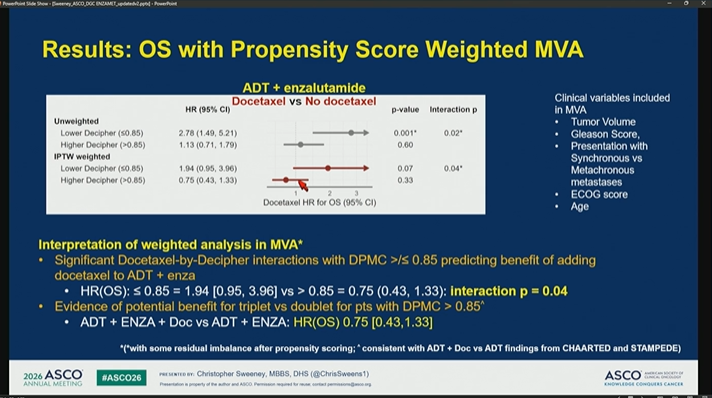
| Analysis | Lower Decipher (≤0.85) | Higher Decipher (>0.85) | Interaction p |
|---|---|---|---|
| Unweighted HR (95% CI) | 2.78 (1.49, 5.21) | 1.13 (0.71, 1.79) | 0.02 |
| Unweighted p-value | 0.001 | 0.60 | |
| IPTW weighted HR (95% CI) | 1.94 (0.95, 3.96) | 0.75 (0.43, 1.33) | 0.04 |
| IPTW weighted p-value | 0.07 | 0.33 |
+2 more figures


8 details
Post-hoc genomic-classifier analysis of the ENZAMET ADT + enzalutamide cohort, N=320, testing whether Decipher (DPMC) predicts docetaxel benefit. Docetaxel receipt was investigator-elected, not randomised, so a propensity-score IPTW model carries the comparison.
mHSPC on an ADT + enzalutamide backbone with an evaluable Decipher score, split at the prespecified 0.85 cut. A separate panel restricts to low-volume disease.
Overall survival, read two ways: prognostic (Decipher stratum on ADT + enza) and predictive (docetaxel-by-Decipher interaction).
Prognostic signal is the cleanest number on the slide deck: HR 3.02 (1.50-5.76) for DPMC >0.85 on ADT + enza. The predictive claim rests on the interaction, p=0.02 unweighted and p=0.04 after IPTW, not on either stratum reaching significance.
Docetaxel was not randomised within this cohort, so IPTW is doing the causal work and the authors concede residual imbalance after propensity scoring. Low-volume panel numbers are small (n at risk 14 and 13 in the reported strata) with a CI of 1.70 (0.32, 8.06), wide enough to be uninformative.
Presented as level 1B evidence consistent with CHAARTED and STAMPEDE, where docetaxel benefit concentrated in high-volume disease. This analysis proposes a genomic rather than volumetric selector for the same decision.
The strongest defensible claim is the prognostic one: DPMC >0.85 marks worse OS on ADT + enza. The predictive claim (add docetaxel above 0.85, omit it below) is directionally consistent across unweighted and weighted models but is not established by a single non-randomised interaction.
Post-hoc biomarker subgroup with non-randomised docetaxel use; both stratum HRs non-significant after weighting, residual imbalance conceded. Read rests on an interaction p=0.04.
- Prospective validation of Decipher-guided docetaxel selection in mHSPC
- Does the 0.85 cut hold on ARSI backbones other than enzalutamide
- Whether low Decipher predicts docetaxel harm or only absent benefit
📚 Sources · 🐦 1 tweet
#ASCO26 GU Oncology Spotlight 🚨
— Dra. María Natalia Gandur Quiroga (@nataliagandur) May 30, 2026
🔬 ENZAMET + Decipher | Part 2
Can genomics guide docetaxel intensification in mHSPC?
Outstanding presentation by @ChrisSweeney1.@OncoAlert@ASCO
After Part 1, the key question was:
➡️ Can a genomic classifier identify which patients with… pic.twitter.com/nJYMxuXelV
The longer read
The useful way to read this is as two claims of very different strength wearing one headline. The prognostic claim is solid and internally consistent: on an ADT + enzalutamide backbone, a Decipher score above 0.85 marks substantially worse overall survival, HR 3.02 (1.50-5.76). That is a large separation, it comes from a randomised trial's own cohort, and it does not depend on any modelling choice. It tells a clinician which mHSPC patients are heading for trouble on a doublet, which is worth knowing even if nothing else here holds up.
The predictive claim is the one being sold and the one that needs scrutiny. The proposition is that docetaxel added to ADT + enza helps above the 0.85 cut and can be avoided below it. The supporting evidence is an interaction, p=0.02 unweighted and p=0.04 after IPTW, with neither stratum's docetaxel hazard ratio reaching significance in the weighted model: 1.94 (0.95, 3.96) below the cut and 0.75 (0.43, 1.33) above it. An interaction that survives only at conventional significance while both of its component estimates cross 1.0 is a hypothesis, not a selection rule. It is also worth noting what drives it. The lower-Decipher estimate points toward worse survival with docetaxel, not merely absent benefit, and it is the larger and more precisely estimated of the two. The interaction is therefore powered substantially by an apparent harm signal in the low-score group rather than by a demonstrated gain in the high-score group, and a harm signal in a non-randomised treatment assignment is exactly where confounding by indication would be expected to show itself.
That non-randomisation is the central methodological fact. ENZAMET randomised the ARSI question; docetaxel use within the enzalutamide arm was elected by investigator and patient. Whatever made a clinician reach for a triplet in 2015 to 2019 (volume, symptoms, fitness, age, pace of disease) is correlated with both the exposure and survival. The propensity model adjusts for tumour volume, Gleason, synchronous versus metachronous presentation, ECOG and age, which covers the obvious axes, and the authors concede residual imbalance persists. Note also that weighting moved the estimates materially in both strata, which is a fair indicator of how much confounding was present to begin with and invites the question of how much remains unmeasured.
Against the existing literature, this sits alongside CHAARTED and STAMPEDE rather than superseding them. Those trials established docetaxel benefit and located it, by clinical volume, in high-burden disease. What is proposed here is a swap of selector, genomic risk for volumetric burden, on a modern ARSI backbone that neither of those trials tested. That is a genuinely interesting question, because volume is a crude proxy and the decision it gates (three months of cytotoxic therapy on top of an ARSI) deserves a better one. But swapping a selector validated in randomised comparisons for one derived post hoc from a non-randomised comparison is a step down in evidentiary grade, whatever the level of evidence label attached to it.
What would have to be true for this to be wrong is unremarkable and plausible: that patients with lower Decipher scores who received docetaxel differed systematically from those who did not in ways the five adjustment covariates do not capture. Prospective validation with docetaxel randomised within Decipher strata is the test this needs.