GETUG P05
ForIntermediate-risk localised prostate, N0M0, no ADT, IPSS ≤15, age ≤80
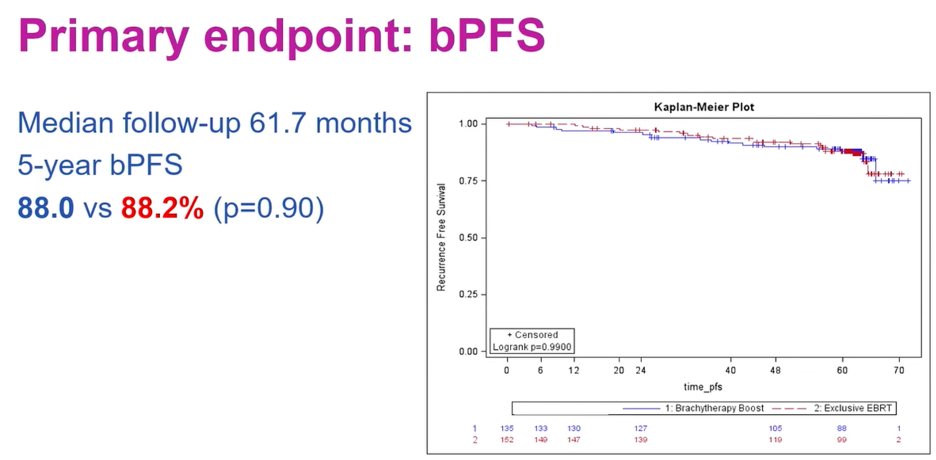
88.0% vs 88.2%
p=0.90, no difference
TL;DR5-yr bPFS 88.0 vs 88.2% (p=0.90): 46 Gy EBRT + LDR/HDR boost no better than 80 Gy EBRT in IR prostate without ADT.
The toxicity ledger cuts against the boost: late GU G2 34.1% vs 17.9% (all-grade p=0.0006), against acute GI sparing only. With 5-yr bPFS flat in both GG2 and GG3, this questions offering a brachy boost over 80 Gy EBRT in IR disease treated without ADT.
In intermediate-risk prostate cancer treated without ADT, this questions adding an LDR/HDR boost over dose-escalated EBRT for bPFS; it does not address boost with ADT, higher-risk disease, or hypofractionated or SBRT comparators.
The toxicity ledger cuts against the boost: late GU G2 34.1% vs 17.9% (all-grade p=0.0006), against acute GI sparing only. With 5-yr bPFS flat in both GG2 and GG3, this questions offering a brachy boost over 80 Gy EBRT in IR disease treated without ADT.
+3 more figures
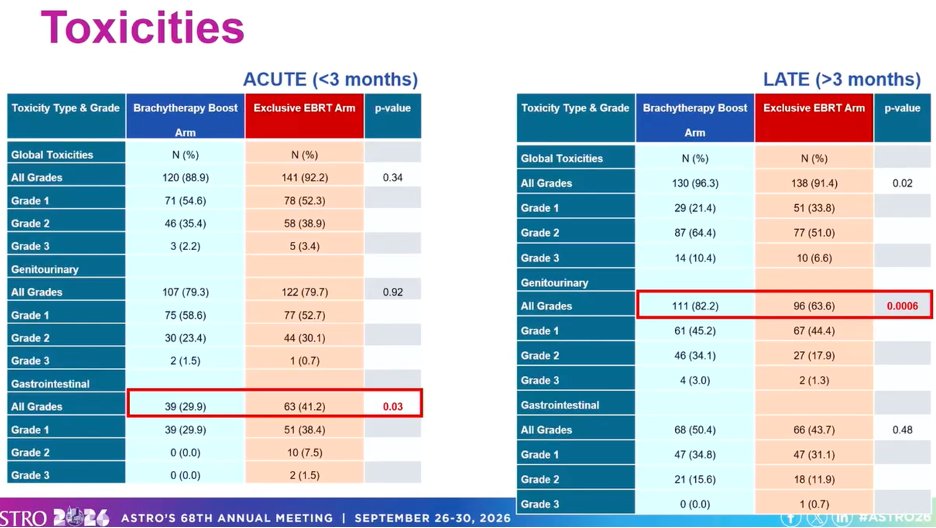
| Toxicity (all grades) | Brachytherapy boost | Exclusive EBRT | p |
|---|---|---|---|
| Acute GU | 107 (79.3) | 122 (79.7) | 0.92 |
| Acute GI | 39 (29.9) | 63 (41.2) | 0.03 |
| Late GU | 111 (82.2) | 96 (63.6) | 0.0006 |
| Late GI | 68 (50.4) | 66 (43.7) | 0.48 |

11 details 1 trial watching
Phase 3 RCT, 1:1, n=288, presented at ASTRO 2026. Median follow-up 61.7 mo.
Histologically proven intermediate-risk prostate adenocarcinoma, age 18-80, expected survival ≥10y, ECOG ≤2. Excluded T3a or greater, ADT, nodal or distant mets, IPSS >15, active IBD.
Both arms: EBRT 46Gy in 2Gy fx to prostate + 1cm SV. Boost arm: LDR 110Gy or HDR 14Gy 1-4 wks after EBRT. Control: 34Gy EBRT boost to prostate, 80 Gy total over 8 wks.
Primary: 5-yr bPFS. Secondary: toxicity, OS, PCSS, IPSS, IIEF-5, QLQ-C30.
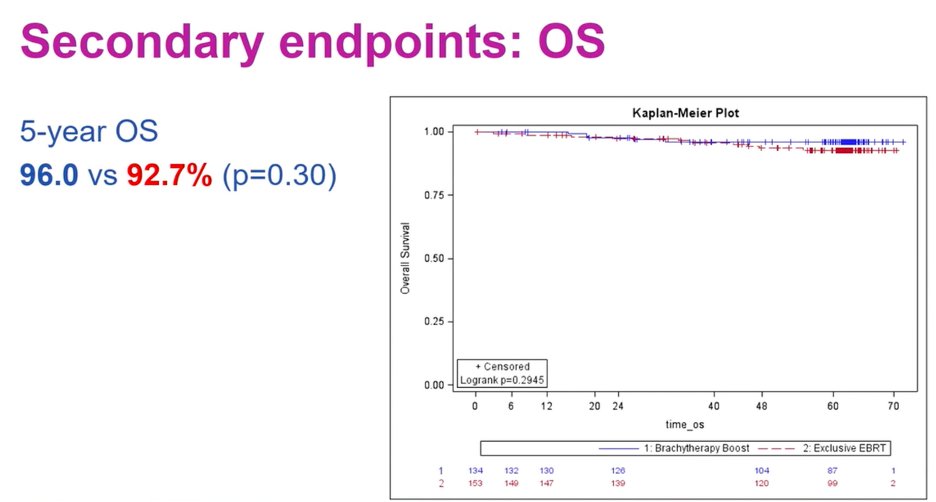
5-yr bPFS 88.0 vs 88.2% (p=0.90), with no benefit in GG2 or GG3. 5-yr OS 96.0 vs 92.7% (p=0.30).
Boost lowered acute GI all-grade toxicity (29.9 vs 41.2%, p=0.03) but raised late GU (82.2 vs 63.6%, p=0.0006). Late GI similar (p=0.48).
ASCENDE-RT, the main randomised support for an LDR boost over dose-escalated EBRT, gave ADT and enrolled a higher-risk mix. GETUG P05 tests the boost without ADT in IR disease and finds no bPFS gain.
LDR and HDR boosts are pooled. Power, margin, and bPFS definition not in source. The 2Gy-fraction 80 Gy control predates hypofractionated standards.
In IR disease without ADT, 80 Gy EBRT already reaches about 88% 5-yr bPFS, which leaves little room for a boost to add anything. The extra late GU morbidity makes routine boosting hard to justify here. Whether a gap opens with longer follow-up is unsettled.
Randomised phase 3 with prespecified bPFS primary, null at 5 yr; diverges from ASCENDE-RT boost benefit. Power not in source, and IR bPFS separation may need longer f/u.
- Does a bPFS benefit emerge with longer follow-up?
- LDR vs HDR boost outcomes not reported separately active Improving Quality of Life After Prostate Brachytherapy: a Comparison of HDR and LDR Brachytherapy Phase NAn=195 · primary completion 2019-12 · randomised HDR vs LDR boost, PSA recurrence-free survival
- Boost vs hypofractionated or SBRT EBRT in IR disease
📚 Sources · 🐦 1 tweet
GETUG P05: Ph 3 RCT of 46 Gy EBRT + LDR/HDR brachy boost vs dose-escalated 80 Gy EBRT in IR PCa, no ADT (n=288)
— Rashid K. Sayyid (@RKSayyid) September 28, 2026
🔹5-yr bPFS: 88% vs 88.2% (p=0.90)
🔹No bPFS benefit in iether GG2 or 3 pts
🔹5-yr OS: 96% vs 92.7% (p=0.30)
🔹Acute GI toxicity lower w/ brachy: 30% vs 41% (p=0.03)… pic.twitter.com/qoxDCnJV4b
The longer read
The case for a brachytherapy boost in prostate cancer has rested largely on ASCENDE-RT, which compared an LDR boost with dose-escalated EBRT and favoured the boost on biochemical control. That trial gave ADT and enrolled a population weighted toward higher-risk disease. GETUG P05 asks a narrower question that matters for daily practice: in intermediate-risk disease, with no ADT, does a boost add anything over 80 Gy external beam? On the primary endpoint the answer is no. Five-year bPFS of 88.0 vs 88.2% is about as null as a randomised comparison gets, and the absence of a signal in either GG2 or GG3 makes it harder to argue that the effect is hiding in a less favourable subgroup.
The obvious objection is follow-up. A median of 61.7 months is reasonable for a trial in intermediate-risk disease, but biochemical failure after dose-escalated RT accrues slowly, and the boost advantage in prior work became clearer with longer observation. A gap could still open. Still, with curves essentially superimposed at five years, any late divergence would have to come from a small number of events in a population where most pts are already controlled. The KM slide also prints a log-rank p of 0.9900 against a headline of 0.90, which needs to be cleared up in the full report but does not change the direction of the result.
The toxicity data are where the trial moves practice most. The boost reduced acute GI toxicity, including all acute GI grade 2 and 3 events, but the late picture runs the other way. Late GU toxicity of any grade was 82.2 vs 63.6% (p=0.0006), late GU grade 2 nearly doubled (34.1 vs 17.9%), and late global grade 3 was 10.4 vs 6.6%. Late GU morbidity matters more to pts over the long run than transient bowel symptoms, so for a reader weighing a boost in intermediate-risk disease, the trade is unfavourable when control is equal.
Several design features limit how far this travels. LDR and HDR boosts are pooled, and the source gives no separate outcomes, so a reader with an HDR-only programme cannot tell whether the late GU excess belongs to one technique. The control arm is 80 Gy in 2 Gy fractions over eight weeks, which many centres have replaced with moderate hypofractionation or SBRT. The result therefore shows that a boost does not beat conventional dose escalation, not that it fails against modern regimens, which were never tested. The design also excluded ADT, so the trial cannot address whether a boost interacts with hormonal therapy as it may have in ASCENDE-RT.
The practical read is that in intermediate-risk disease treated with RT alone, dose-escalated EBRT reaches the same biochemical control with less late GU morbidity, and a boost needs a reason beyond bPFS. What remains open is whether high-risk features, ADT, or longer follow-up recover a boost benefit, and how a boost compares with ultrahypofractionated external beam.