DASL-HiCaP NCT04135353
ForVery high-risk or N1 prostate, radical or early salvage RT + 2y ADT
HR 0.42
95% CI 0.27-0.66, p=0.0001; 4-yr MFS-CI 95% vs 88%
TL;DR4-yr MFS-CI 95% vs 88%, HR 0.42, adding darolutamide to prostate/bed + pelvic LN RT and 96 wk ADT in very high-risk prostate cancer.
Every metastasis-free survival (MFS) difference comes from metastases (9 vs 46). Deaths without prior metastases were 18 vs 17. Both arms got prostate/bed plus pelvic nodal RT with 96 wk ADT, so this is darolutamide on top of an already intensified RT backbone, in both radical and salvage settings. RT dose was not reported.
For a very high-risk patient (GG5, GG4 with adverse T stage or PSA, or cN1/pN1) planned for pelvic nodal RT with 2y ADT, this supports discussing darolutamide intensification. It does not extend to shorter ADT courses or to RT without nodal coverage.
Darolutamide cut metastases (9 vs 46) even though both arms got pelvic nodal RT and 96 wk ADT, so nodal coverage did not remove the distant-failure risk the drug addresses. The result covers both radical and early salvage RT. Dose/fractionation is not in the source, so it can't be checked against your own regimen.
The secondary endpoints all point the same way: time to CRPC HR 0.22 (0.09-0.52) and subsequent hormonal therapy HR 0.36 (0.21-0.60). This makes darolutamide the ARPI with placebo-controlled data alongside 2y ADT and RT. OS HR 0.88 (0.49-1.59) is still immature.
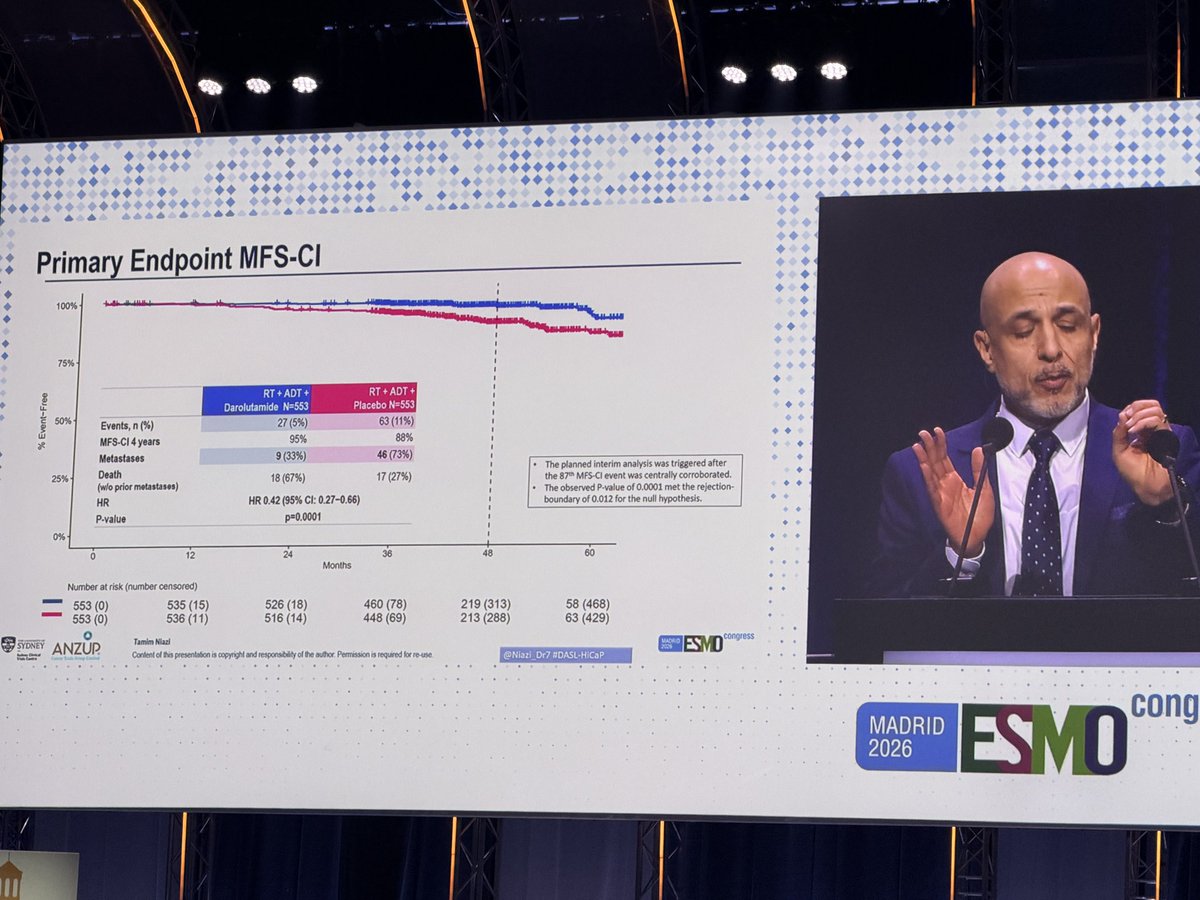
| MFS-CI | RT + ADT + Darolutamide N=553 | RT + ADT + Placebo N=553 |
|---|---|---|
| Events, n (%) | 27 (5%) | 63 (11%) |
| 4-yr MFS-CI | 95% | 88% |
| Metastases | 9 (33%) | 46 (73%) |
| Death (w/o prior metastases) | 18 (67%) | 17 (27%) |
| HR (95% CI), p | 0.42 (0.27-0.66), p=0.0001 | ref |
+2 more figures
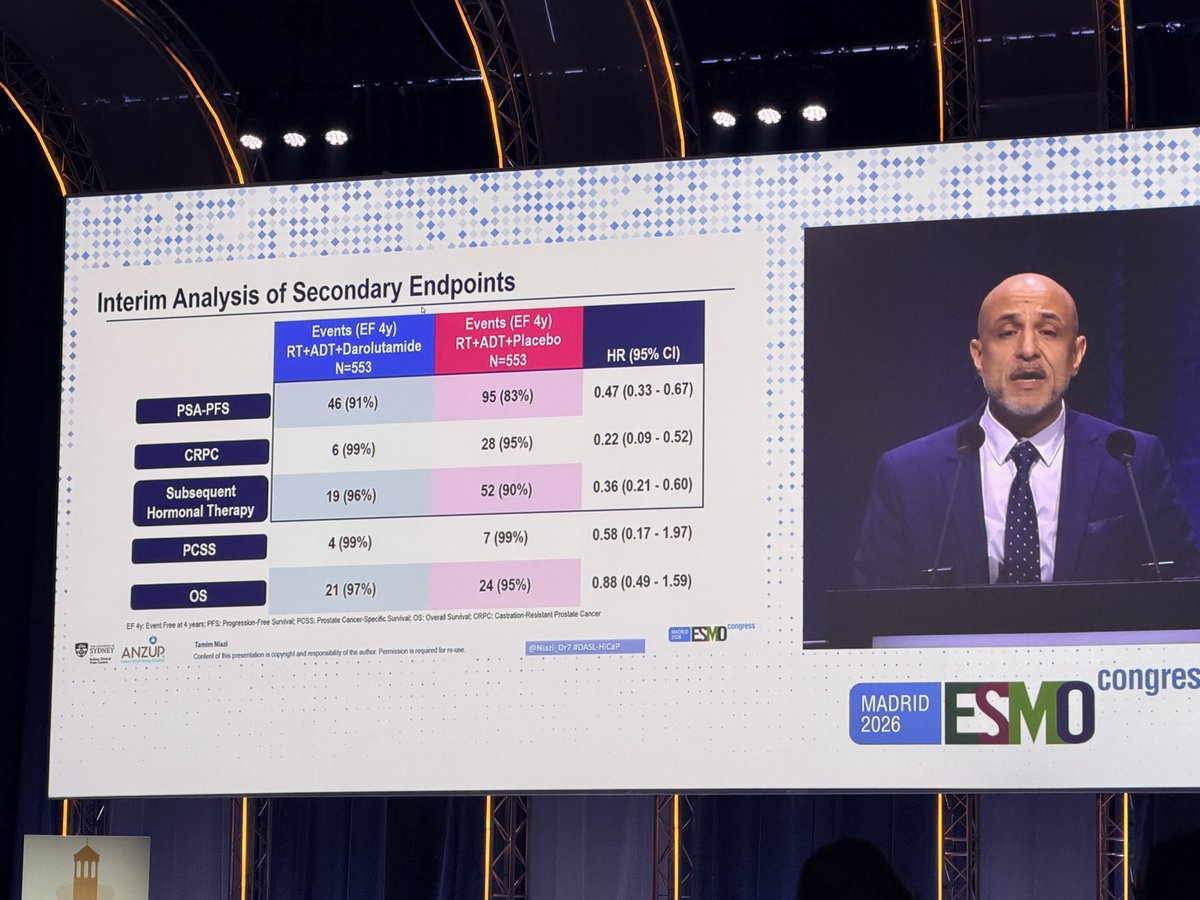
| Secondary endpoint (interim) | HR (95% CI) |
|---|---|
| PSA-PFS | 0.47 (0.33-0.67) |
| CRPC | 0.22 (0.09-0.52) |
| Subsequent hormonal therapy | 0.36 (0.21-0.60) |
| PCSS | 0.58 (0.17-1.97) |
| OS | 0.88 (0.49-1.59) |
9 details
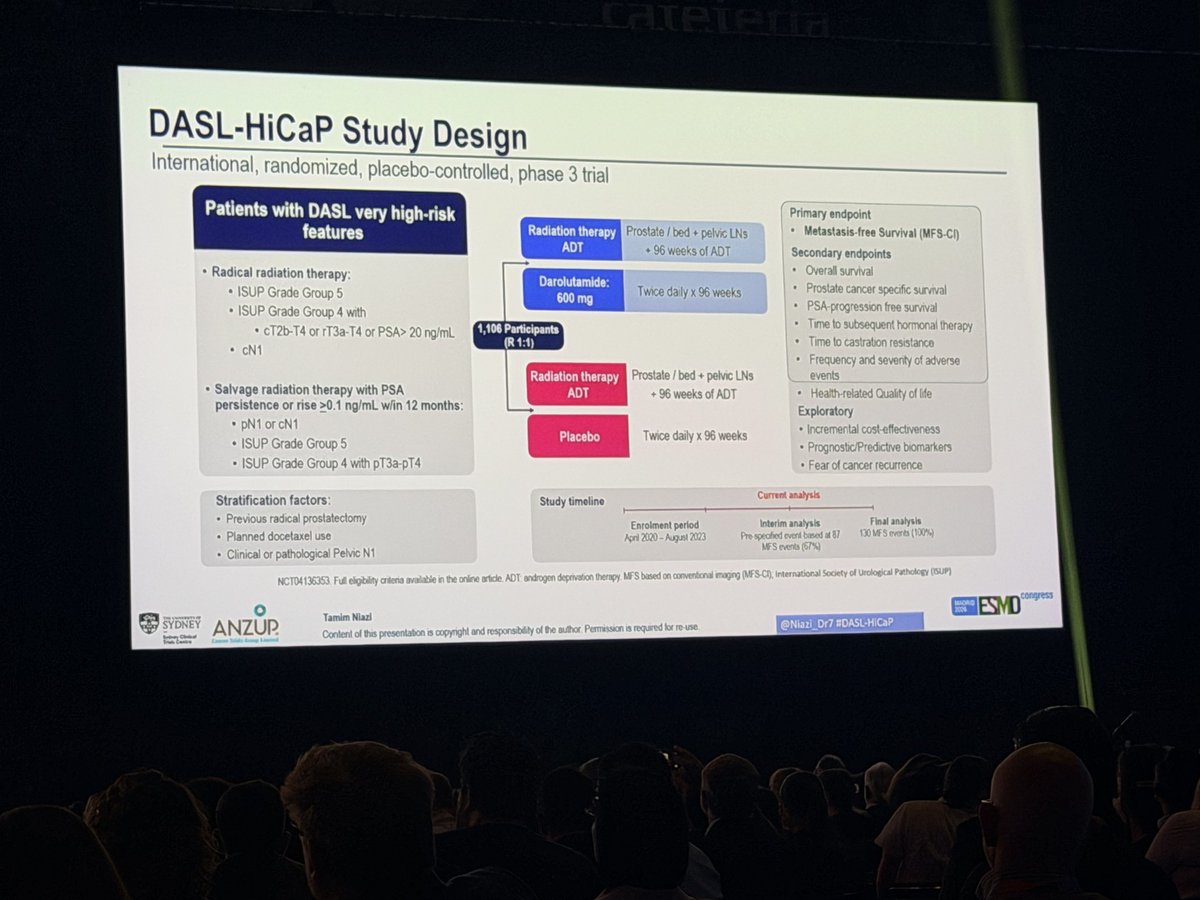
International, randomized, placebo-controlled phase 3, 1:1, N=1,106. Enrolment April 2020 to August 2023. Interim analysis triggered at the 87th MFS-CI event (67%); final analysis planned at 130 events.
DASL very high-risk pts getting radical RT (ISUP GG5, GG4 with cT2b-T4 / rT3a-T4 / PSA >20 ng/mL, or cN1) or salvage RT for PSA persistence or rise ≥0.1 ng/mL within 12 mo with pN1/cN1, GG5, or GG4 pT3a-pT4. Stratified by prior RP, planned docetaxel, pelvic N1.
Darolutamide 600 mg BID x 96 wk vs placebo. Both arms got 96 wk ADT. Docetaxel use was allowed as a stratification factor.
Both arms: prostate/bed + pelvic LNs. Dose, fractionation and imaging used for staging are not reported in the source.
Primary: MFS by conventional imaging (MFS-CI). Secondary: OS, PCSS, PSA-PFS, time to subsequent hormonal therapy, time to castration resistance, AEs, HRQoL.
Primary met at interim, HR 0.42 (0.27-0.66), p=0.0001, against a rejection boundary of 0.012. Authors report the benefit was consistent across all subgroups (no subgroup HRs in source).
Authors describe the treatment burden as similar to placebo. No AE rates or grade breakdown in source.
This sits alongside ENZARAD and the STAMPEDE M0 abiraterone work, which ask the same ARPI-plus-RT intensification question. DASL-HiCaP is the placebo-controlled test, it mandates pelvic nodal RT in both arms, and it includes an early-salvage cohort.
Event-driven interim with only 27 vs 63 events, so the estimate may shrink by the final analysis. MFS is read on conventional imaging, which may not match PSMA-staged practice. Primary vs salvage results are not shown separately.
The drug's effect is on metastases, not competing mortality, which supports a real anticancer benefit. Whether it becomes an OS benefit at PCSS HR 0.58 and OS HR 0.88 is still unknown.
CONSORT flow
Clean placebo-controlled phase 3, but this is the interim analysis (87/130 events). MFS is a surrogate and OS is immature. The prespecified final analysis is the gate.
- Does the MFS benefit translate to OS at final analysis?
- Is benefit similar in salvage vs radical RT cohorts?
- Does the effect hold in PSMA-PET staged pts?
📚 Sources · 🐦 1 tweet
DASL-HiCaP at #ESMO26, presented by @Niazi_Dr7: darolutamide + RT + 2 yrs ADT vs placebo in very high-risk prostate cancer (n=1,106)
— Alan Tan (@alantanmd) October 24, 2026
▪️ MFS HR 0.42, 4-yr MFS 95% vs 88%
▪️ PSA-PFS HR 0.47
▪️ Time to CRPC HR 0.22
▪️ OS immature (HR 0.88)#ProstateCancer pic.twitter.com/pfDHyuM2qW
The longer read
DASL-HiCaP asks the question that STAMPEDE's M0 abiraterone comparison and ENZARAD have circled for years: in a non-metastatic, very high-risk population already getting RT and long-course ADT, does adding a next-generation androgen receptor inhibitor change the natural history? What sets it apart is the control arm. Both arms got prostate or prostate-bed RT with pelvic nodes and 96 weeks of ADT, so the comparator is close to the most intensive local and hormonal backbone in current use, not an under-treated control. Any benefit here is on top of that backbone, which matters for an RT reader who already treats this group with nodal fields.
The split of events is the most informative detail. Metastases accounted for 9 of 27 events with darolutamide and 46 of 63 with placebo, while deaths without prior metastases were 18 and 17. Competing mortality is flat and distant failure is cut sharply. That pattern is what a real anticancer effect looks like, and it argues against the worry that a composite surrogate is being moved by noise. It also means that in the darolutamide arm about two-thirds of MFS events are now non-metastatic deaths. That has two consequences. Further MFS gains will be hard to see, and the OS signal will be diluted by deaths the drug cannot prevent. The interim OS HR of 0.88 with a CI from 0.49 to 1.59 says nothing yet.
The interim design calls for some restraint. Stopping at 87 of 130 planned events with a p-value well inside its boundary is legitimate, but early-stopped trials tend to overstate effect sizes, and an HR of 0.42 based on 90 total events has a wide interval. The endpoint is read on conventional imaging. A PSMA-staged population would likely enroll fewer occult-metastatic pts, which could lower the control-arm event rate and shrink the absolute benefit, though the relative effect may hold. The source also does not separate the radical-RT and salvage cohorts. These are biologically different groups, and the claim of a consistent subgroup effect comes without numbers.
For practice, the strongest supported read is darolutamide added to 2 years of ADT and pelvic nodal RT in pts meeting these specific criteria. The authors report limited extra treatment burden, but no AE rates are in the source, so the toxicity trade-off can't yet be judged against the competing ARPI options. The trial does not address shorter ADT, prostate-only fields, or whether the drug can replace some of the ADT. The final analysis and mature OS will decide whether the authors' 'new paradigm' framing is borne out or turns out to be an early-stopping overestimate.